Side Bet Frequencies Shifting House Edges in Live Blackjack Variants Globally
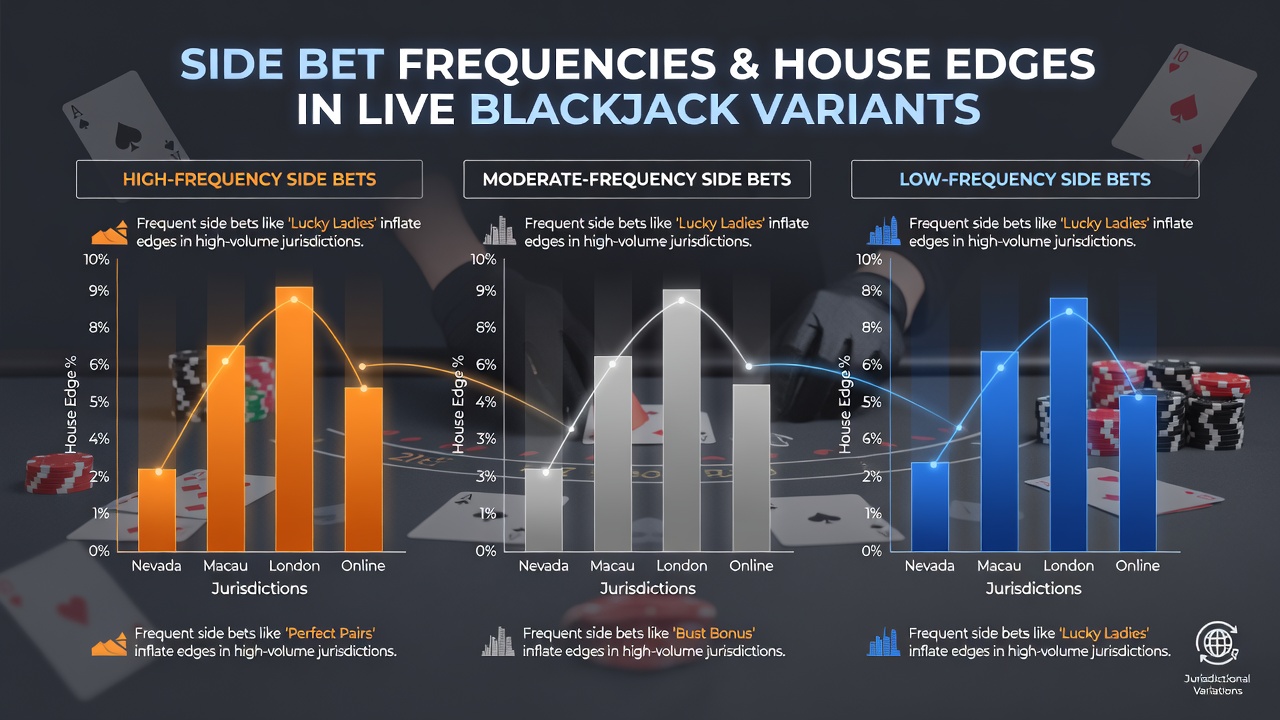
Side bets in live blackjack introduce separate wagering opportunities that carry distinct house edges, and their usage rates directly influence the overall mathematical advantage operators maintain across different regulatory environments. These additional bets, including options like Perfect Pairs and 21+3, operate independently from the main game yet players activate them at varying frequencies depending on table rules, payout structures, and jurisdictional oversight.
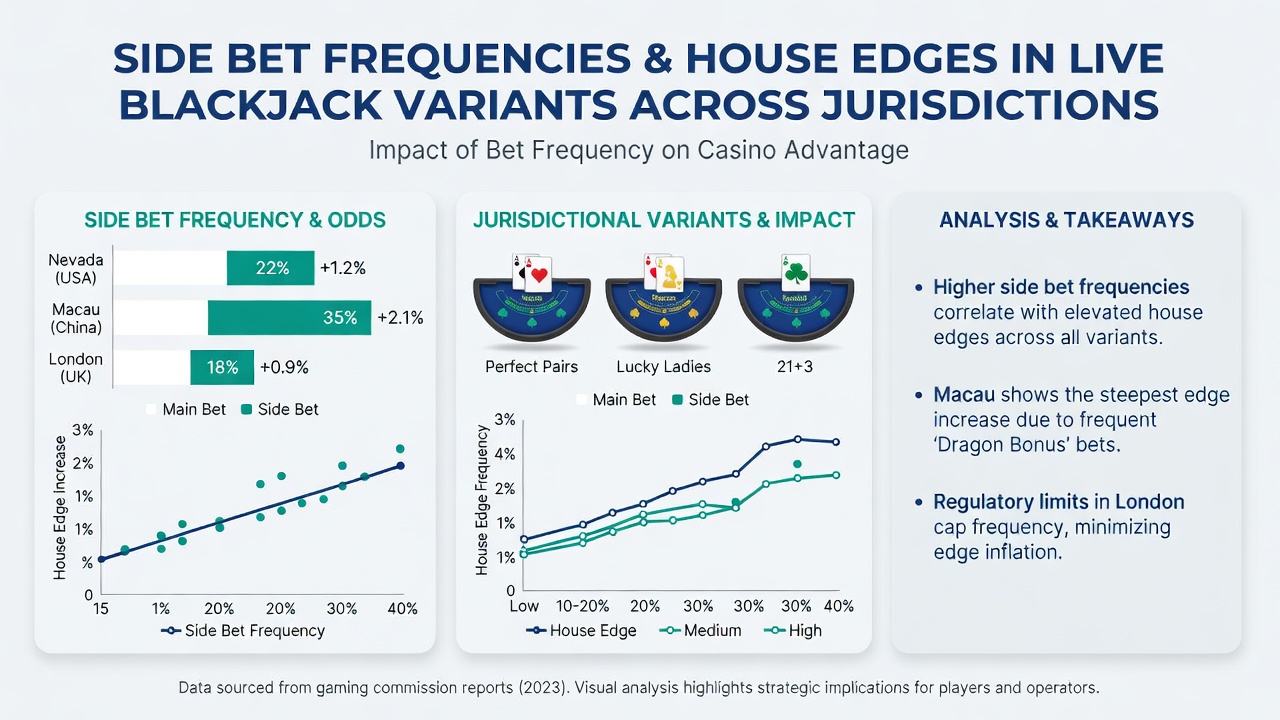
Data collected from casino floors in multiple regions shows that side bet participation can range from 15 percent to over 40 percent of total wagers placed during a session. Higher frequencies amplify the contribution of these bets to the composite house edge because most side bets carry theoretical returns between 2 percent and 12 percent in favor of the house, whereas the core blackjack game often sits below 1 percent under favorable rules.
Core Mechanics Behind Side Bet House Edges
Operators calculate house edges for side bets through combinatorial analysis of card distributions and payout ratios, then track how often players elect to place those wagers during actual play. In jurisdictions such as Nevada and New Jersey, gaming control boards require operators to publish aggregate return-to-player figures that incorporate both main game and side bet activity, revealing how elevated side bet frequencies push overall edges higher even when main game rules remain constant.
Researchers at institutions focused on gaming mathematics have documented that each additional side bet taken per hand increases the effective house edge by a weighted average of the individual bet edges multiplied by their occurrence rates. When players take side bets on roughly one out of every three hands, the composite edge can rise by 0.8 to 1.5 percentage points depending on the specific bet types offered at the table.
Regional Differences in Side Bet Availability and Regulation
European markets operating under Malta Gaming Authority licenses often restrict side bet menus to a narrower set of options compared with North American venues, which limits the maximum frequency impact but still produces measurable shifts when players engage with available choices. Australian regulatory frameworks administered through state-level commissions similarly cap certain progressive side bets while mandating clear disclosure of individual house edges, allowing analysts to isolate frequency effects more precisely.
Canadian provinces have introduced varying disclosure requirements since early 2025, and observers note that tables in Ontario display side bet return percentages separately from main game figures, enabling clearer tracking of how participation rates alter session outcomes. These regulatory approaches create datasets that researchers can compare across borders to quantify frequency-driven edge changes without relying on single-jurisdiction assumptions.
Frequency Data and Composite Edge Calculations
Industry reports compiled through 2026 indicate that side bet frequency peaks during promotional periods when operators temporarily boost payout ratios, yet the underlying edge remains elevated enough that sustained higher participation still favors the house. One study released in cooperation with the University of Nevada Las Vegas gaming research program examined over 2 million hands across multiple properties and found that a 10 percent increase in side bet frequency correlated with a 0.3 percentage point rise in overall house edge when Perfect Pairs and Insurance bets dominated the additional wagers.
Turns out the relationship holds across live dealer platforms as well, where digital tracking captures exact bet placement timing and amounts, allowing regulators in jurisdictions like those overseen by the Kahnawake Gaming Commission to monitor compliance with published edge figures. The same datasets reveal that players who avoid side bets entirely experience house edges closer to the theoretical minimum established by main game rules alone.
Impact of July 2026 Regulatory Updates
By July 2026 several North American and European regulators had aligned on standardized reporting templates that separate side bet performance metrics from core blackjack statistics, making frequency effects more transparent to both operators and independent analysts. These updates facilitate cross-jurisdictional comparisons that previously required custom data requests, and early figures already show consistent patterns where tables advertising higher side bet payouts attract greater participation yet post modestly elevated composite edges.
What's interesting is how these reporting changes have prompted some operators to adjust side bet payout schedules downward in response to observed frequency spikes, thereby stabilizing the overall house edge without altering main game rules. The adjustments maintain compliance while reflecting real-world player behavior captured in the new standardized datasets.
Conclusion
Side bet frequencies function as a controllable variable that operators and regulators can monitor to understand composite house edge movements in live blackjack across diverse jurisdictions. Continued collection of participation data under evolving disclosure standards will further clarify how these additional wagers interact with core game mathematics, offering precise insights into edge dynamics without reliance on anecdotal observation.