Tracing Multiplier Distribution Curves in Networked Progressive Jackpot Systems

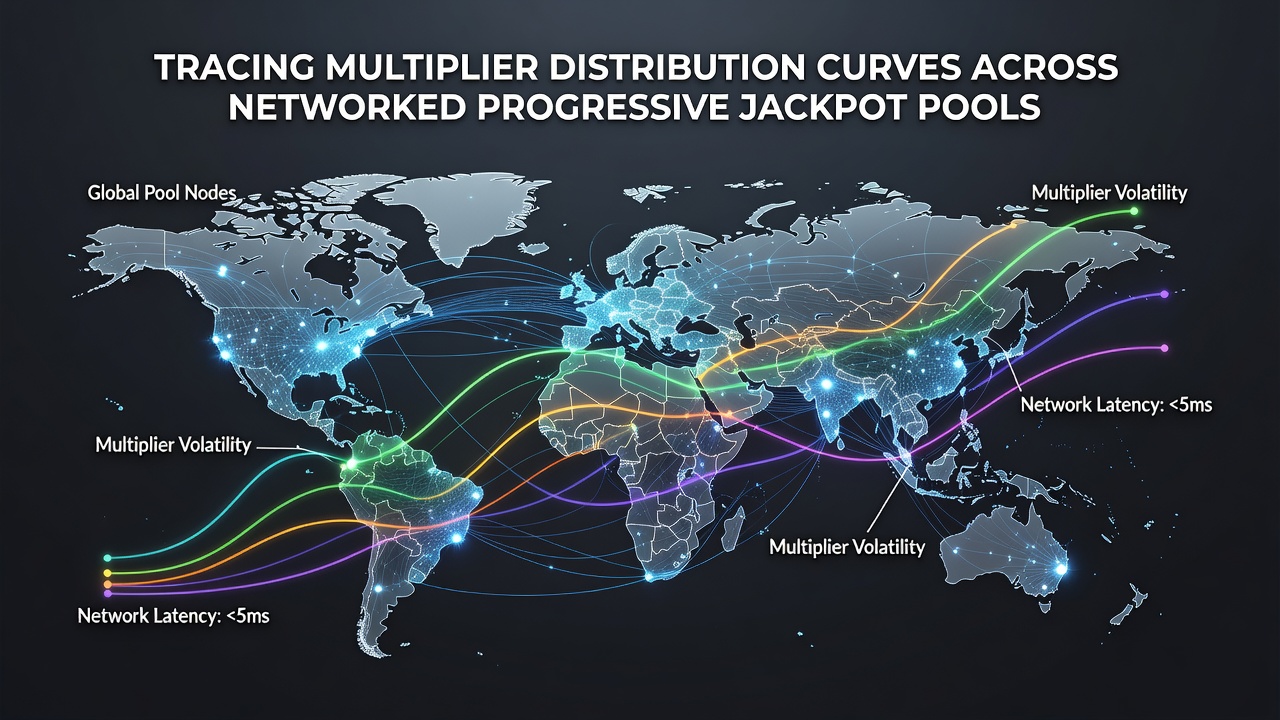
Networked progressive jackpot pools connect multiple gaming platforms across different operators and regions so that contributions from each spin feed into shared prize pools, and multiplier distribution curves emerge as key indicators of how often certain payout multipliers occur within those expanding systems.
Operators track these curves to understand the frequency of low, medium, and high multipliers because the shape of each curve reveals patterns in player contributions and jackpot growth rates over time.
Understanding the Basics of Networked Pools
Progressive jackpots accumulate funds from a percentage of each wager placed on linked games, and when several networks merge their pools the resulting data sets become large enough for statisticians to plot multiplier distributions with greater precision. Researchers plot these distributions on logarithmic or linear scales depending on whether they examine raw payout data or normalized frequency counts.
Multipliers in these environments typically range from 1x up to several thousand times the base bet, yet the probability mass concentrates at lower values while rare high-multiplier events drive the long tail of the curve.
Data Collection Methods Across Regions
Analysts gather timestamped transaction logs from servers located in multiple jurisdictions, then align the records to a common time standard before calculating the empirical distribution of multipliers that appeared during each observation window. Government agencies in Australia and Canada publish aggregated reports that supply baseline participation figures for cross-network comparisons, allowing researchers to normalize curves against total wager volume.
One study released by the American Gaming Association examined pooled data from North American operators and found that multiplier frequencies followed a truncated power-law pattern rather than a simple exponential decay during the first half of 2026.
Curve Shapes and Their Implications
When plotted on log-log axes the distribution often shows a linear segment at moderate multiplier values before bending downward at the extreme high end because jackpot caps and regulatory limits prevent unlimited growth. Observers note that slight changes in contribution rates or pool segmentation alter the slope of that linear segment, shifting probability mass toward either the body or the tail of the curve.
Technicians apply maximum-likelihood estimation to fit theoretical models such as log-normal or Weibull distributions to the observed data, and goodness-of-fit tests help determine which model best captures the behavior of a particular network during a given month.
Seasonal and Regulatory Influences in Mid-2026
Activity levels recorded through June 2026 showed modest increases in average pool size across several European-linked networks, and the corresponding multiplier curves displayed a subtle flattening in the mid-range as more players contributed to the same shared pots. Regulatory adjustments in select provinces altered minimum contribution percentages, which in turn compressed the right tail of the distribution for affected games.
Industry reports indicate that networks incorporating real-time contribution adjustments maintained more stable curve parameters month to month, whereas fixed-rate pools experienced greater variance when player volume fluctuated.
Analytical Tools and Visualization Techniques
Software packages commonly used for this work include R and Python libraries that generate kernel density estimates alongside parametric fits, allowing side-by-side comparison of empirical and theoretical curves. Heat maps layered over time-series plots highlight periods when high-multiplier events clustered, revealing potential correlations with promotional campaigns or new game releases.
Teams at research institutions sometimes overlay multiple network curves on the same axes to identify whether segmentation by game type produces measurably different distribution shapes, and these comparisons help operators decide how to allocate marketing resources across titles.
Future Monitoring Approaches
Continued expansion of cross-border networks will generate larger data volumes, which in turn supports finer-grained segmentation of multiplier curves by time of day, player cohort, and device type. Automated monitoring systems already flag statistically significant deviations from baseline curves, prompting manual review when an unexpected shift appears.
Conclusion
Tracing multiplier distribution curves across networked progressive jackpot pools supplies operators and regulators with quantitative insight into payout behavior and pool dynamics. Continued refinement of statistical methods and broader data sharing among non-UK jurisdictions will likely improve the accuracy of these models through the remainder of 2026 and beyond.